| If over-fishing continues, commercial marine species could go the way of Lanka’s legendary pearl fisheries, which died out completely, warns environmentalist. |
|
| Malaka Rodrigo reports | |
Over-fishing
is reducing fish populations to dangerously low levels in the Indian
Ocean and seas around the world, warned fisheries experts.
Dr. Rekha Maldeniya of the National Aquatic
Resources Research and Development Agency (NARA) delivered the keynote
speech at a seminar on Marine Biodiversity, on May 22, which was
designated the International Day on Biological Diversity.
Over-fishing led to the demise of the pearl oyster stocks, in Mannar, Dr. Maldeniya reminded the audience. Sri Lanka was once famous for its pearls, but that industry has died out completely, and the same fate awaits other fish species unless precaution is taken, she said. Management decisions are being delayed by a lack of sufficient data for a good understanding of the country’s coastal and marine ecosystems. “There is a lot of ongoing research on land-based ecosystems, but not enough research on marine ecosystems. Marine biodiversity research is expensive, and we do not have enough trained people to do the research. Even the little research output we have, such as the Environmental Impact Assessments, is under-utilised. While our main concern is commercially valuable fish species, other marine creatures are also under great pressure.” Weak enforcement of laws and regulations has also contributed to the decline in coastal fish stocks. Dynamiting and the continued use of banned types of fishing nets must end if fish stocks are to be maintained. Some countries use large nets such as the purse seine to catch tons of fish. Such action depletes stocks very quickly. Taking management action, the expert said, is not easy, as many fish stocks overlap ocean areas belonging to different countries. Some pelagic fish, like tuna, are migratory, so protection by one country alone does not ensure a species’ survival. All marine habitats are interconnected. For example, certain marine fish come to estuaries to breed, and if the estuaries are not protected, the species is threatened. Habitat loss, degradation and fragmentation, destructive fishing methods, pollution, the spread of invasive alien species – all are serious threats to marine life. Sri Lanka exports 20,000 metric tons of fish a year. A total of 650,000 people are employed in the fisheries industry, including 150,000 fishermen, 100,000 in fishing-related services, and 400,000 in the fish trade. Up to 2.4 million persons are sustained by fish consumption. Fish species contribute to 70 per cent of the country’s animal protein consumption. How much life is there in the sea? The marine biodiversity found around Sri Lanka ranges from microscopic algae to the giant Blue whale. During a 10-year period, from 2000 to 2010, scientists around the world collaborated in an unprecedented effort to determine how much life there is in the sea. The Census of Marine Life, carried out under the Convention of Biodiversity, involved 2,700 scientists from more than 80 countries. They studied surface seawater and probed the deepest, darkest depths of the ocean, sailed tropical seas and explored ice-strewn oceans in the Arctic and the Antarctic. By the time the census was concluded, a total of 1,200 new species had been added to the known roster of life in the sea. Scientists are still working their way through another 5,000 specimens to determine whether they are new discoveries. The number of known marine species is estimated at around 250,000. In its final report, the census team suggested the number could be at least a million, while others believe the figure could be double that. Source:http://www.sundaytimes.lk/120527/News/nws_24.html |
Sunday, May 27, 2012
Ocean fish populations dropping to alarmingly low levels


There’s a bark for every snakebite: Banda veda
| E.M.Banda from a remote village in the hills says he has cured more than 3,000 snakebite victims | |||||
| By Wasantha Ramanayake | |||||
|
He is a simple old man from a remote village,
claiming to have cured/saved more than 3,000 snakebite victims, free of
charge. It is not because he is rich, but considers it unethical to
charge a fee from a person who is already in distress. E.M. Banda, 84, is a native snakebite doctor, residing in a simple house, “Veda Nivasa”, in Wagolla, Palle-Inguruwatte, Inguruwatte, Mawathagama, among hills accessible via a difficult narrow road, a few kilometres away from Watareka junction, on the Mawathagama-Rambukkana road.
He was born in 1929, and studied at Watareka School, a few kilometres from his home. His mother died when he was 16. He could still remember how the children, biting a piece of stick, crawled into trenches, to hide from the Japanese bombers.His father, E.M. Dingiri Banda was a famous native snakebite doctor. There were four children, two girls and two boys. Banda was the only child who followed in his father’s footsteps, to become a native doctor. “Father always said that I could not be a good doctor, he always expected more from me,” he said. His father died in 1967. Banda claims to have effective snake-charms against cobras and mapilas. For cobras, he would sprinkle sand, on which a charm has been recited, around the compound of the house, which will make it out of bounds for reptiles. For mapilas, it is a written charm that hung on the wall. According to him, deadly venomous snakes are a number of mapila species, cobras, vipers, and kraits. “When there’s protection, even a mongoose could not come into the compound,” he said. “None whom I have treated to date, have died,” he declared. He could not say how many patients he had treated, but believes it could be more than 3,000, since he began practising,” he added. He said it is difficult to treat a person who was unconscious. “First I use nasnaya, a mixture of herbs to treat those who are unconscious, and once the person regains consciousness, he could be treated. I have never sent anybody to government hospitals for treatment,”he said. Commenting on not charging a fees he said, “How can I charge a fee from someone who is in distress? But of course, most of them visit me with gifts, after they are cured.” He cultivates paddy and has a banana cultivation, although the market is very poor, he says. His elder brother lives in Kurunegala, looking after his rubber trees and gets an income. “I always work. I am used to working a lot,” he said. “A snakebite victim fears for his life. Calm the victim and make him/her lie down, assuring of a doctor’s attention soon. Then apply some lemon on the bite, and apply a tourniquet above the bite, with a hair,” says Dingiri Banda when discussing first aid steps. He said a strip of bark from the thel endaru (castor oil) tree could be used to tie up the place just above the bite. Medical assistance should be sought immediately. He does not recommend washing with water. His advice is to avoid places frequented by snakes such as termite hills, undergrowths and to light one’s way at night. He said there is a proven first aid to spider as well as snakebites. “Take divi kaduru (Eve’s apple) leaves, peel the bark of the tree and some raw turmeric and common salt. Pound them in a mortar and heat the mixture in a pan. Apply the mixture on the bite. This could relieve the pain,” he said. For paththaya or centipede bite, ekaweriya (rauwolfiaroot) leaves with lemon juice, and for wasp attacks karanda roots should be ground with lemon juice. For spider-bites, he recommends thinly sliced divipahuru leaves mixed with raw, ground turmeric and salt mixture to be mildly heated and applied on the bite.
“It is a pity that most young people today do not know what the trees and plants around them are,” he lamented. He said that certain plants are difficult to find. “Twenty- thirty years ago, there were fewer houses and trees and plants were everywhere,” he added. He has some of the medicinal plants in his home garden. “Earlier, people knew most of the medicinal plants, because they took native treatment. They were not used to western medicines, as they have to go a long way to a Government hospital,” he observed. Answering the question whether snakes shouldbe spared, he said, “They should not be killed, they are part of our world. Generally, snakes do not bite, unless somebody steps on them accidentally, or handles them. But there are occasions when they could be angry because they are disturbed while mating or if you happen to cross their paths, when they are after some prey,” he said. He said there are less snakes in their home gardens now, as there are more houses and open spaces. But there are more snakes during the rainy season, and also during the paddy harvesting season in paddy fields and also in rubber estates. Commenting on who will succeed him in the line of curing snakebite victims, he said he has three daughters of whom one lives in Polpithigama in the Kurunegala district, who does some practice. The other two are afraid to take on the responsibility he says. “My daughter-in-law however is competent and confident. She can treat and also knows some charms,” he revealed. He said that many have expressed the wish to share his knowledge, but he has already decided who should carryon his work. “It should be my daughter-in-law, otherwise there would be a conflict of interest,” he said. When it comes to his own wellbeing he said he did not usually take medication for any ailment. Once in away he takes a paracetamol. But mostly, he uses herbs and herbal medicine. He would boil a mixture of garlic, uluhaal (fenugreek seeds) and pepper together in a pot of water and drink it for any stomach ache. Source:http://www.sundaytimes.lk/120527/News/nws_26.html |


DWLC conducts probe into army shooting on jumbos
The Department of Wildlife and Conservation (DWLC) has launched an
investigation why the army shot two wild elephants in Bundala yesterday.
According to environmentalists one jumbo was shot in the head and the other sustain similar gun shot injuries.
Meanwhile, DWLC Veterinary surgeon Dr Vijitha Perera had rushed to the scene to treat the injured animals. It was found one elephant had killed a girl in a village of Bundala and also injured her father two days ago.
Source:http://www.sundayobserver.lk/2012/05/27/oostory.asp?sid=20120224_01&imid=shoot.jpg&dt=[February%2024%202012]
According to environmentalists one jumbo was shot in the head and the other sustain similar gun shot injuries.
Meanwhile, DWLC Veterinary surgeon Dr Vijitha Perera had rushed to the scene to treat the injured animals. It was found one elephant had killed a girl in a village of Bundala and also injured her father two days ago.
Source:http://www.sundayobserver.lk/2012/05/27/oostory.asp?sid=20120224_01&imid=shoot.jpg&dt=[February%2024%202012]
Monday, February 20, 2012
Birds detected at BIA raises Interpol concern
|
| The recent detection at the BIA of an attempt to smuggle several exotic varieties of birds into the country has triggered interest of the Interpol that is probing whether this was part of a global live animal trafficking trade. Interpol’s Environmental Crime Committee in a letter to the Criminal investigation Department (CID) has requested any intelligence that the CID may have gathered from investigations into the illicit trafficking of birds, the Sunday Times learns.  The recent detection was of a consignment of 121 live birds brought down by a regular importer who had documents to support the import of only ten birds as per the permits issued by the Department of Wild Life Conservation (DWC). These permits are given only after a quarantine report is obtained from the importer as required under the Convention on International Trade in Endangered Species of Wild Fauna and Flora (CITES). The market value of the birds was around Rs. 13.6 million but the declared value was just US $ 1130 (around Rs. 120,000). The man was fined Rs 450,000 and the birds were handed over to the National Zoological Gardens where they will go on display in about a month’s time. The ten birds for which the man had proper documentation were handed over to him. While most of the birds were varieties of parrots, what was disturbing was that among them were several small exotic varieties of duck and a pair of swans which are high-risk carries of Avian flu (bird flu). Customs Bio-Diversity unit Director General Samantha Gunasekera who led the detection having kept tabs on the importer for more than a year and having been tipped off by an informant said this was perhaps one of the few cases that was detected while in other instances live animal and bird cargo are smuggled into the country for ornamental purposes to be sold at exorbitant rates. Another shocking revelation was the amount people are willing to pay to buy different types of macaw and cockatoos to keep as pets. The blue and gold Macaw, indigenous to South America is sold at around Rs.1. 2 million while prices of other exotic birds range between Rs. 100,000 and Rs. One million. (See graphic for prices of imported birds sold in Sri Lanka). “The bird consignments come from Bangkok but the birds originate from South America, Australia or New Zealand,” Mr.Gunasekera said. While the Customs Department makes the detections, the quarantine office run by officials of the Department of Animal Production and Health (DAPH) are entrusted with checking live cargo. “The importer has to inform the Department when the consignment is due and our officials check them when they arrive to give clearance. If there is some suspicion we keep the animals or birds at a quarantine centre outside the airport and release them later,” a spokesman for the Department Dr. Susil Silva said. However, the Sunday Times learns that the DAPH has come under criticism particularly that the live cargo is not examined properly and that regular importers are allowed to leave with the goods without proper scrutiny. When questioned Dr.Silva said the Department works with the resources available and that so far the Department has ensured that no diseases are brought into the country. “We have to implement the Animal Diseases Act and that is what our officials do,” he said. The Sunday Times found out that with varying government agencies involved in enforcing laws pertaining to this area, there seemed a lack of co-ordination. For example the Department of Wild Life Conservation (DWC) which issues permits and is entrusted with carrying out raids now functions under the Ministry of Agrarian Services and Wild Life whereas it was earlier under the Ministry of Environment which formulates policy on environment related matters. The co-ordination between the DAPH and the Customs too seemed inadequate. Environment activist and lawyer Jagath Gunawardena said although the Flora and Fauna Ordinance provides adequate laws to deal with the import and export of live and endangered species of both animal and plant what was lacking was its implementation as well as trained officers. “The law has been amended to meet present day situations but it has to be better implemented and we need more trained personnel so that we can close the loopholes that exist,” he said. Meanwhile, Samantha Gunasekera of the Customs said that other than the import of live animals, the unchecked import of various types of plants and fish too has proved to be hazardous to local bio diversity. “I warned many years ago that the import of piranhas and knife fish was detrimental to the survival of fish species. Their import was banned much later but now these fish are found in our waterways,” he said. He added that similarly other types of animal imports could cause much harm. “The Customs sometime back detected a pair of ferrets that had been imported as pets but these creatures are a highly invasive species and if released into the wild could wreak havoc by killing off many of the smaller animals found here,” he said.  One of the 121 consignment of birds that were detected at the airport. Pic by Mangala Weerasekera “We need to educate the public as well as have better trained people to ensure that both local bio diversity is protected and there is no trafficking of endangered species,” he added. Permits before pets The Department of Animal Production and Health has reiterated that those who want to bring their pets (cats, dogs, birds etc.) into the country need to obtain an import permit from the Department prior to their arrival in Sri Lanka. An official said despite many public notices to this effect, many airline passengers still continue to bring pets without a valid permit and this has caused inconvenience to the quarantine officers who are forced to send them back to the countries from where they were flown in. He said, sometimes the pets are not accepted by the respective countries and are sent back to Sri Lanka, causing further inconvenience to officials and the owners. Locals target endemic birds as pets A bird-import racket was busted by the Customs last week, but another covert and illicit bird trade is being conducted within the country. The operatives catch birds in remote areas, sometimes deep in the jungles, and supply these to pet shops. The law allows only exotic birds to be kept as pets, but these pet shop owners deal in any indigenous birds. Parrots, munias, the black-headed oriole, grackles and even sparrows are among the birds being traded. The grackle, or Hill Myna, known locally as Salalihiniya, is especially vulnerable. The bird is in big demand because it comes under the business category of “birds that can talk.” The racket came to light last year when a Galle resident was caught in the act of delivering grackles caught in the wild to a pet shop in Mount Lavinia. Acting on a tip-off that birds were being transported to Colombo, Madura de Silva and Nadeeka Hapurarachchie of the Wildlife Conservation Society of Galle, accompanied by members of the Flying Squad of the Department of Wildlife Conservation, lay in wait near the Mt. Lavinia pet shop in question.  The grackle, or Hill Myna A three-wheeler drew up in front of the pet shop, and a man stepped out. He was caught in the act of handing over a plastic crate containing grackles to the pet shop owner. The man told the Flying Squad the grackles were caught in the jungles of Gampola. He said he had also supplied other bird species, including the Layard’s Parakeet, a bird endemic to Sri Lanka. It is understood that the illicit bird business has been going on for quite some time. The bird supplier and the pet shop owner were both fined.Madura de Silva told the Sunday Times that there seems to be a growing demand for endemic local birds. Some of these birds have permanent nesting sites, and repeatedly visit the same tree and tree hole to lay their eggs. This makes them easy prey to bird catchers. It is quite common for villagers to keep birds, such as the mynah and the rose-ringed parakeet, as pets. Usually, these are birds that have been found abandoned or lost as fledglings, and out of compassion the villagers adopt the birds and take care of them. It is a different situation in the towns and city, where illegal bird trading is a lucrative business. While these birds may not be threatened species, they could be in danger if they became heavily targeted species, warned Madura de Silva. All indigenous and migratory birds, except five bird species, are protected under the Fauna and Flora Ordinance of Sri Lanka. The five unprotected species are the Large-billed Crow, the House Crow, the Rose-ringed Parakeet, the Scaly-breasted Munia and the white-backed Munia. The Rose-ringed Parakeet and two species of Munia are often available for sale in pet shops. It is illegal to keep even unprotected bird species without a licence, says environment lawyer Jagath Gunawardane. He believes there are a few organised groups engaged in the illicit bird trade, but the “situation is not out of control.” He recommended a proper investigation to review the situation. Source:http://sundaytimes.lk/120219/News/nws_13.html |
Sunday, February 19, 2012
Where every plant in the land gets a birth certificate
| In addition to its serene beauty that draws hordes of visitors, there are many things that the Peradeniya Botanical Gardens can be proud of, one of which is the National Herbarium where vital work related to the floral wealth of this country is carried out, reports Kumudini Hettiarachchi |
For most, it is just a walk through the gardens, sometimes enjoying the misty splendour or at other times the sunbathed glory of the well-laid out land by the quietly flowing Mahaweli. Relaxing under the canopy of a large tree, walking along the hallmark avenue of royal palms or looking in wonder at the bright and beautiful flowers, how many realize that the Royal Botanic Gardens at Peradeniya has the highest diversity among gardens in the region. The National Herbarium houses a collection of 148,000 dried specimens from all over the country. Pix by M.A. Pushpa Kumara While providing a serene and tranquil environment, proven by the fact that 1.4 million are lured by its beauty, Peradeniya plays many roles - a major one being the ex-situ conservation of plants. This is the conservation and maintenance of living organisms, in this case plants, outside their natural habitats.  There are 4,500 different species of plants including trees, shrubs, bushes et al, the Sunday Times learns. With the air in Kandy said to be more polluted than Colombo, this Botanic Gardens is reported to have the best air in the area. Behind the manicured and tended areas is also taking place important work connected to the flora of Sri Lanka. Deep within the Peradeniya Gardens in a charming building fitted with wooden almirahs, glass-showcases and numerous shelves, meticulously preserved are specimens of each and every plant or tree in the country. It is the National Herbarium with a massive collection of 148,000 dried specimens reported from all over the country, even the remotest corner, the Sunday Times understands. With the specimens come detailed information on where and when the plant was collected, its habitat, colour and the name of the collector. Explaining that some of the specimens at this national bio-repository are nearly 200 years old, the Director-General of the Department of National Botanic Gardens, Dr. Siril Wijesundera said the National Herbarium represents a valuable floral catalogue. This is where the "birth certificates" of plants are, he says, adding that the National Herbarium is also involved in plant exploration, identification, specimen preparation and documentation and revision of the floral wealth of the country. Here is the Wintergreen plant taken way back in 1855 at Horton Plains, says Dr. Wijesundera walking us through the National Herbarium, pointing out that when the leaves of the plant are crushed the wintogeno odour comes out strongly. Colour-coded with red being for "native" plants, green for cultivated plants and brown for exotics or aliens, if the plant is not at the Herbarium either it is new to Sri Lanka or new to science as in not being named, he says. As such a Herbarium is vital to study plant taxonomy (coming from the Greek taxis or "arrangement" it means the practice and science of classification), the geographic distribution of plants and also their nomenclature. Flowers, stems, leaves, seed and fruit are preserved alongside a specimen, according to Dr. Wijesundera.  Dr. Siril Wijesundera shows some of the specimens The staff at the National Herbarium is also involved ‘Red Listing’ plants in the country in collaboration with the Biodiversity Secretariat of the Environment Ministry. Plants are categorized as 'extinct', 'critically endangered', 'endangered', 'vulnerable', 'near-threatened', 'least concerned' and 'data deficient'. Close to the National Herbarium is another building, now refurbished and equipped for batches of people to pore over microscopes, mix different chemicals in petri dishes for experiments involving plants or listen to both local and foreign experts. In this building now turned into an education centre, Louis Mountbatten, the Supreme Commander of the Allied Forces in South Asia made his office in the hill country, as well as an ammunition dump during World War II in the early 1940s. The other achievement that the Botanic Gardens is proud of is the National Floriculture Development Programme, 'Suvahas Mal' under which 85 farmer organizations have been empowered in different spheres such as infrastructure, plant material and knowledge to cultivate both flowering and ornamental plants. The farmer organizations are in the Central, North Central, Western, Sabaragamuwa, Uva and Southern Provinces, according to the Director General and at the Botanic Gardens the nucleus where the growers have been trained is the model farm with green houses where rows and rows of orchids, anthuriums and other flowers are nurtured. Proving his initial point that it is not just a malwatte, Dr. Wijesundera's vision is to make the Peradeniya Royal Botanic Garden "the best in the tropics" by 2015 by maintaining that special quality that emanates from here……..the aura of tranquillity and serenity, along with its pristine majesty. History of our gardens The history of the Peradeniya Gardens goes back into the dim mists of time when in 1371 King Wickramabahu III first used it as a royal pleasure garden, followed by King Kirthi Sri Rajasinghe declaring it as a 'Royal Garden’ in 1780. By 1799, close to Colombo in Peliyagoda, the then British Governor Frederick North established a botanic garden in 1799, with the services of Frenchman Eudelin de Jonville. 'Kew Gardens' with Joseph Banks taking a hand came into being in 1810 in Slave Island, Colombo, with the first Superintendent William Kerr being appointed in 1812. However, relocation at Ukgalboda on the banks of the Kalu Ganga at Kalutara followed in 1814 and Alexander Moon took up the mantle in 1817. Peradeniya became the home of these gardens in 1821. Source:http://sundaytimes.lk/110508/Plus/plus_09.html |
Killer croc at Muthurajawela marsh strikes
People are not aware that attacks are usually premeditated, says expert


“They have vowed to look after my children,” sobs Anne, as the tiny home in ‘Meegaha-watte’ down Weli Para, Peliyagoda, is coming back to normal. The funeral having been held on February 1, the small shed erected on the road to accommodate the crowds is about to be dismantled and the plastic chairs stacked in corners. Inside their home on a low teapoy is the photo of Kumara with a flame flickering close-by. A cup of tea with milk added has been kept as an offering.
“He didn’t come home that night or early the next morning,” says Anne. The search began the next day, with the men of the watte being mobilised by Kumara’s brother, Sebastian Joseph. Retracing Kumara’s movements, they came to the Ragama marsh and found the three-wheeler as well as the bundles of grass close by.
“His good clothes were in the three-wheeler and a few coins were scattered inside as well,” says Joseph re-living the trauma, pointing out that of the two sickles Kumara usually took with him to cut grass, only one was found in the three-wheeler.
The banian which he wears when cutting the grass was found some distance away, soaking wet but on dry land, close to a murky pool, on the bank of which the three-wheeler ignition key was also found, according to him.
After the watte tharunayo cleared the mucky edges of the pool, the Navy swimmers found his brother’s leg in the water. His shorts, with pahuru gapu (scrape) marks were also found in the water, says Joseph.
The head and the upper torso had been found only last Tuesday, theSunday Times learns.
Kumara had left his wallet along with his driving licence and his identity card at home, murmurs Anne wondering whether he had a premonition of what would befall him.
Three-wheeler driver Suranga Ranjith Silva who has followed the crocodile saga from day one has told officials of the Department of Wildlife Conservation (DWC) that he is willing to catch the creature.
We can lure it with a godura (bait) and then trap it with a noose. We will not harm it, he says.
However, according to him, officials from the DWC office at Muthurajawela have told the people in the area to inform them if they spot a crocodile.
“Will the crocodile await their coming,” grumbles a resident, with others agreeing that it is not the solution.
The routine of humble Sebastian Angelo Uday Kumara, 36, may probably have rung the death knell for him that fateful Friday at Ragama, just a stone’s throw from the busy town and hospital.
For, as Kumara went about his usual work of getting into the ‘Meda’ marsh knee-deep to cut the grass and bundle it up and then walk a little distance to wash off the mud, the predator lurking in the murky waters may very well have eyed him on several days and waited grabbing him as dusk fell on January 27.
Above: The wife and two children of the victim whose picture is at right
When the Sunday Times visited the area, a knot of men and women gathered to express fear over a possible crocodile attack. Yes, said a woman, with the others nodding in agreement, a crocodile has been sighted in the area, with dogs and goats going missing.
“Kimbulek avva thapinawa dekala thiyenawa,” said 16-year-old Roshan Vimukthi who used to play cricket on the pitiya with his friends, explaining that he had seen a crocodile sunning itself with its jaws wide open. It was about 15 feet long.
S. Piyumi, living on the embankment opposite the pool where parts of Kumara’s body had been found, says that when her dogs barked furiously she heard a splash and saw the last bit of a croc’s tail vanish into the depths of the water hedged in by habarala.
A person points to the spot where the victim entered the marsh. Pix by M.A. Pushpa Kumara
Fearful for their children, especially if there is heavy rain and the houses get flooded as they are prone to, the people called for immediate action to prevent crocs from roaming this urban area. A week after Kumara went missing and parts of his body were found at the marsh, his wife Anne Sunethra Dilshani, 10-year-old son Chanaka and eight-year-old daughter Niroshini are struggling to come to grips with the thought that the husband/ father is no more. With the breadwinner gone, the family will be dependent on the kindness of relatives, mainly Kumara’s brothers and sister.
“He didn’t come home that night or early the next morning,” says Anne. The search began the next day, with the men of the watte being mobilised by Kumara’s brother, Sebastian Joseph. Retracing Kumara’s movements, they came to the Ragama marsh and found the three-wheeler as well as the bundles of grass close by.
“His good clothes were in the three-wheeler and a few coins were scattered inside as well,” says Joseph re-living the trauma, pointing out that of the two sickles Kumara usually took with him to cut grass, only one was found in the three-wheeler.
The banian which he wears when cutting the grass was found some distance away, soaking wet but on dry land, close to a murky pool, on the bank of which the three-wheeler ignition key was also found, according to him.
After the watte tharunayo cleared the mucky edges of the pool, the Navy swimmers found his brother’s leg in the water. His shorts, with pahuru gapu (scrape) marks were also found in the water, says Joseph.
The head and the upper torso had been found only last Tuesday, theSunday Times learns.
Kumara had left his wallet along with his driving licence and his identity card at home, murmurs Anne wondering whether he had a premonition of what would befall him.
Three-wheeler driver Suranga Ranjith Silva who has followed the crocodile saga from day one has told officials of the Department of Wildlife Conservation (DWC) that he is willing to catch the creature.
We can lure it with a godura (bait) and then trap it with a noose. We will not harm it, he says.
However, according to him, officials from the DWC office at Muthurajawela have told the people in the area to inform them if they spot a crocodile.
“Will the crocodile await their coming,” grumbles a resident, with others agreeing that it is not the solution.
| Open verdict as full body not found yet Ragama Coroner M. Priyankara Lal who held the inquest into Kumara’s death has returned an open verdict, fixing the next hearing for February 24. The post-mortem examination conducted by Consultant Judicial Medical Officer, Dr. Indira Kitulwatte, had found that the injuries on the recovered parts of the body were consistent with kimbulek sapa kema, explained the Coroner, adding that because the whole body had not been found he gave an open verdict. Time has been given so that the missing leg and lower torso including the stomach may be recovered, it is learnt. Warning boards necessary Boards warning of croc attacks should be put up immediately in the area, stressed Anslem de Silva, Vice Chairman, Crocodile Specialist Group IUCN/SSC for South Asia and Iran, advising that people who live or work in croc habitats must not engage in a regimented routine.Do not repeat the same action, at the same location, at the same time, he urges. Among the eight killer-crocodiles in the world are both the Saltwater and Mugger crocs which are found in Sri Lanka. The Saltwater crocodile along with the Nile croc (found in Egypt) tops the list, the Sunday Times learns. Pointing out that many attacks are due to the ignorance of humans, Mr. de Silva said people who go into crocodile habitat are not aware of both the attitude and activities of these creatures. Croc attacks are usually premeditated, says this expert who has investigated more than 150 such incidents across the country, adding that they “watch and wait.’ ‘Mr. Saltwater Croc’ found in the Ragama area may have been watching Kumara, bent or squatting washing himself before pouncing, he says. Once the croc’s teeth get gridlocked on human flesh, it is one of the biggest forces. The croc will then drag its victim under water, drown him, tear the body into pieces and hide them amidst the underwater root systems, for it prefers the putrefied remains. Commending moves by the DWC under the guidance of Wildlife Minister S.M. Chandrasena to set up massive enclosures of 1-2 acres for both species of crocodiles at Muthurajawela, Mr. de Silva adds that then ‘croc trouble-makers’ from all over the country could be trapped and released there, to reduce the human-crocodile conflict.  |
When croc and man lived a ‘charmed’ life
| Our very own crocodile dundee, Anslem de Silva brings world focus on traditional methods used by our ancestors, to co-exist with this much-maligned reptile. |
Four-legged or no legged, big or small, ambling or slithering, whatever forms the natural dangers took, our ancestors seemed to have known how to deal with them. Not only did they deal with them effectively, be it elephant, snake or crocodile, they also passed down their knowledge, sometimes ingrained in stone to posterity. Mr. de Silva rescued this five-foot Mugger from a fishing net in Jaffna and released it After his arduous search across the country, Anslem de Silva, well-known for his work on creatures slimy and slithery, has brought the strange but amazing “traditional methods” that Sri Lankans deploy in the prevention of crocodile attacks to world-focus. This is through a well-researched piece in the latest Crocodile Specialist Group Newsletter out on April 26. No stranger to crocodiles, Mr. de Silva had observed these creatures (which interestingly have changed little for many million years since the dinosaurs) while still a boy in his hometown of Matara. During this study, he has not only had long chats with village elders, traditional snake-bite physicians, astrologers and boatmen but also traced families affected by crocodile attacks after meticulously clipping and filing news items of such incidents as well as spreading the word that he would like to be told about such incidents. Two species, the Mugger (Crocodylus palustris) and the Saltwater (C. porosus) crocodiles glide in and out of a variety of habitats such as rivers, streams and wewas (man-made tanks), coming into contact with people who also use these water bodies for drinking, bathing, washing clothes and to earn a living through fishing and harvesting aquatic or semi-aquatic edible and non-edible plants, Mr. de Silva says. Pointing out that both the Mugger and the Saltwater crocodiles are known to attack humans, livestock and pets such as dogs, he explains that people have resorted to various forms of prevention handed down from their ancestors which include both physical and spiritual. Titled ‘Prevention of crocodile attacks in Sri Lanka: Some traditional methods’, Mr. de Silva has put the spotlight on them through the newsletter published in Australia but distributed worldwide by the Crocodile Specialist Group of the IUCN – Species Survival Commission. Delving into spiritual practices including inscribed charms and talismans and protective mantras, this ‘crocodile hunter’ of a different kind has unearthed a granite stone artifact, irregularly hexagonal, around 46 cm in length, width and height, with an intricate talisman engraved on the upper surface, with the charm inscribed on the other four sides. Although now at the Dutugemunu Temple of the Sandarawela Rathnasara Pirivena, in Ganegama, Baddegama, down south, the stone dating from circa 1469-1474 AD had originally been found in the Gin Ganga at Baddegama, Mr. de Silva’s research, funded by the Mohamed bin Zayed Species Conservation Fund, has revealed. 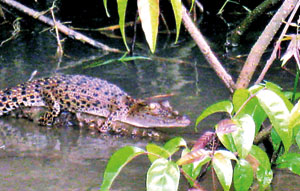 Saltwater baby croc hiding in mangrove vegetation On his forays into the wild as well as to more inhabited areas where men, women and children come face-to-face with crocodiles, his path had been made smoother by the research already in place of former Professor of History and Archaeology, University of Sri Jayewardenepura, Mendis Rohanadeera and the assistance rendered by former Director (General Services) of the Archaeology Department, M.B. Herath. The charm written in stone starts with salutations to Lord Buddha and various deities and then invokes protection for all humans from male and female crocodiles, says Mr. de Silva, pointing out that it ends with the disclosure that “...this is the crocodile charm that tied the crocodiles and she crocodiles”. Incidentally, Rohanadeera’s research has suggested that the charm and talisman are the work of scholar-monk Ven. Thotagamuwe Rahula of the 15th Century who gets a mention in history textbooks in schools. Mr. de Silva has also been told of charmed stones in the Nilwala Ganga, at the main bathing spot in Matara town and at Nadulgala, and in a river at Tissamaharama, but laments that they have not been discovered yet. From granite stones to mantras, he has uncovered two short ones of four to 10 words recorded in 1954 by Gnanaloka which people were supposed to recite before entering waters inhabited by crocodiles. “Om Sumas Shri Devane Muka Bandrama,” was an incantation to god Sumas to tie the mouth of the crocodile not to bite, the Sunday Times understands. Widely known but now extinct in the country, Mr. de Silva recalls just one instance where a police officer of the Mankulam Police Station spoke of a diver from his village of Manampitiya who used charms to protect himself before seeking the bodies of crocodile victims in the Pali Aru and Kidapuchchan kulam. Looking worldwide, he cites Borneo where crocodile charmers are still popular and our very own ‘shark charmers’ of yore who protected divers harvesting oysters during the British era. With dengue on the rise and mosquito repellents both local and foreign being sold over the counter, it comes as no surprise that herbal pills had been used in Sri Lanka to repel even bigger creatures. Bhagawath Jeewara Guliya was the answer for crocodiles, it is learnt, containing plants, seeds and other ingredients but also being prepared under specific conditions and rites governed by auspicious times. There is a strong belief that crocodile attacks could be kept at bay if the pill mixed with the juice of the kotakimbula plant (Ficus hispida) is put into a river or tank infested with crocodiles, Mr. de Silva’s research has found. The toxic effects of various plants such as the unripe fruit of kukuruman (Randia dumetorum) are used by villagers to catch fish, although this practice is prohibited by law, he states, explaining that in Kalkudah people make a paste of unripe kukuruman to poison fish. Have you heard of kimbul kotu, asks this crocodile expert, who along with his team studied 70 of these crocodile exclusion enclosures, both abandoned and in use, along the Nilwala Ganga from Modara to Paraduwa in Matara. Interesting details emerge of these “physical barriers” against crocs. They could be small enclosures (about 3X3m) erected by individual families for bathing and washing clothes and utensils or large enclosures by a pradeshiya sabha or urban council for communal use. A large enclosure opposite Matara town used by many people for several decades had been washed away by the 2004 tsunami but not re-erected, says Mr. de Silva who as a boy had bathed there in the mid-1950s. Traditional enclosures are constructed of thick kitul palm (Caryota urens) planks or long hardwood poles driven firmly into the riverbed, the two ends of the enclosure abutting the banks while those with metal rods and wire have come in more recent times. Traditional and metal enclosures have fencing only on three sides, it is learnt.  Communal crocodile exclusion enclosure All crocodile attacks that occurred during the research period involved people bathing, washing clothes or fishing outside an enclosure or in areas sans one, stressed Mr. de Silva. Meanwhile, he says that sometimes, crocodiles stray into domestic compounds at night, to prey on pets or poultry and this has led to the construction of metal exclusion fences.People’s negligence led to attacks Let them live, is conservationist and current Vice Chairman of the Crocodile Specialist Group, IUCN for South Asia and Iran, Anslem de Silva’s plea to Sri Lankans, not only because he has found that almost all crocodile attacks were due to the negligence of people but also as these reptiles are of vital importance for the ecosystem and thus to the survival of humans. “They are a relic from the past and should be safeguarded. Crocodiles in fact saw the extinction of the dinosaurs.”The victims were aware of the presence of crocs in the water where they were attacked in 90% of the 131 cases examined (interviewed) by Mr. de Silva during his human-crocodile conflict study. “People from the wet zone hill country, who recently settled in the dry zone under the Accelerated Mahaweli Project were initially ignorant of crocodile habits and as such vulnerable, with dry zone tanks being the main Mugger habitats,” he says.  The crocodile charm Based on the accounts of attack victims and witnesses, the Sunday Times understands that the crocodiles had observed people engaged in water-based activities over a period of time before attacking them. “This would imply that some attacks were not the result of a casual encounter with potential prey, but reflected direct hunting,” stresses Mr. de Silva. Words of wisdom and guidance on how the authorities, the government and the local authorities, could protect people from the jaws of crocodiles come from this expert:
|
Subscribe to:
Posts (Atom)