Sunday, February 19, 2012

Sri Lanka over-fished by estimated 600 illegal vessels: report

Feb 19, 2012 (LBO) - The sea around Sri Lanka is facing the danger of being overfished by an estimated 600 illegal vessels a day, and marine reserves may have to be declared to conserve fish stocks, a media report said.


The Sunday Times newspaper quoting John Church, an international fisheries and maritime security specialist as saying that an estimated 600 illegal, unreported and unregulated (IUU) vessels were operating in Sri Lankan waters at any given time.


Most of the media attention in recent times has been on several hundred Indian fishing vessels entering Sri Lankan waters under cover of darkness.

But the Sunday Times said Church told a forum at Kadirgmar Institute in Sri Lanka's capital Colombo that unlicensed Japanese tuna fishing vessels alone may be causing losses of 30 to 50 million dollars in foregone license fees.
Church is involved in a fisheries management protection program for Sri Lanka, the report said.
Church had said Sri Lanka may have to declare about 20 to 25 percent of the coastal zone as marine reserves to prevent depletion of fish stocks. When left undisturbed, fish stocks tend to bounce back quickly, he had said.
Church has said that according to one report 17,000 IUU vessels had entered Sri Lankan waters over a 5 - month period.

The island's fisheries ministry has said a vessel monitoring system has already been selected and will be operational soon.

A weekend in the wild

A peacock’s plumage is one of the most gorgeous sights in nature, but the poor bird is cursed with a hideous shrieking call. This was the sound that woke me up this morning at the rustic house we drove over six hours from Colombo to reach.

Lovingly built by a famous Sri Lankan architect on her paddy field on the edge of the Wasgamua National Park, the house is made of wattle and thatch, and is lit by a feeble solar-powered system. I can’t charge my laptop, so unless I can finish this piece soon, I fear my computer will run out of juice.
But this is an ideal spot to charge my own personal batteries. Last night, we sipped our drinks outside, watching a growing number of fireflies on the surrounding trees. There used to be a lot of these flashing insects when I was growing up. Even as a young man in Lahore, I recall seeing thousands of jugnus in the city’s parks. No more, alas. They say fireflies are a barometer of pollution, and sadly, traffic in cities around the world has wiped them out.

Competing with the fireflies were bright stars that illuminated the sky. There is little light pollution where we are presently, so we can watch the nightly show nature puts on, but is almost invisible in our cities.
The nearby national park is home to elephants, bears, deer and leopards, among many other animals. The lake that laps against our friend’s property was full of numerous birds when we had our coffee on its bank this morning. We were told by our hosts that they had counted 188 species and sub-species of birds around their lovely weekend cottage.

Apparently, elephants often leave the park to raid the surrounding paddy fields, including the one belonging to our hosts. To neutralise the electrified fence that’s supposed to keep them in, they drop branches on the wires, and walk through the gap they have created.

Despite the protection they get in Sri Lanka’s twenty-plus national parks, wild elephants are under threat from several directions. Although the murderous civil war is over, there are still mines that regularly kill and cripple the poor animals. Then there are adult and baby elephants killed by trains; according to specialists, these deaths generally occur when trains are running late.

Apparently, these intelligent animals are aware of normal timings, and keep clear of the tracks. But often, baby elephants get scared and freeze when a train is approaching, and the adults crowd around to protect them. Drivers are unable to stop in time to save the unfortunate animals.

But the biggest threat comes from farmers who protect their fields from hungry elephants by using guns, or explosive devices that usually maim them, and cause them to die in great pain.
Nevertheless, it is remarkable that even during the long civil war, the Sri Lankan state continued to maintain its network of national parks. Millions of acres across the small country have been set aside to protect the abundant wildlife. The fact that hunting is prohibited means that even outside the parks, it is possible to see all kinds of animals and
birds.
Over the last five years or so, Sri Lanka has emerged as a major whale-watching centre. I have seen several varieties of the mammoth cetaceans, together with scores of dolphins that often swim across the boat’s bow as they make playful patterns in the sea.

The biggest national park is at Yalla, towards the east of the island, about an hour and a half from our beach house. I have often bounced through it on open jeeps in an effort to see its elusive leopards. However, this has become such a popular tourist destination that every time a rare animal is sighted, local drivers call their mates on their cells, and within minutes, the spot resembles Oxford Circus at rush hour.

In their frantic efforts to show their clients a leopard and thus earn a fat tip, drivers often take unnecessary risks, and friends tell me two of the big cats have been killed as a result. Add this unpleasant scramble to the deterioration in the roads in the park, and a safari at Yalla isn’t what it used to be. So I, for one, have decided to opt out until things change. Luckily, there are lots of other parks to visit.

In Pakistan, by contrast, virtually unrestricted hunting has decimated our wildlife. The splendid markhor is close to extinction, as is the rare snow leopard. Years ago, I remember going on a fishing trip with friends to Azad Kashmir. When we cast our hooks at a spot on the Neelum River that had been described by the old Gazetteers as being abundant in mahsheer, we were told by a local that the iconic fish had been wiped out in that area. Apparently, army officers would toss hand grenades into the water to stun the fish that would then float to the surface.

Then, of course, the flagrant poaching of the endangered houbara bustard by petty Arab sheikhs with government connivance has been a national scandal for decades. Despite international condemnation, every winter these so-called sportsmen descend on Pakistan with their hawks and their Humvees and kill yet more bustards. As these birds can’t fly very far, I fail to see where the sport lies. Apparently, its meat is supposed to be an aphrodisiac for our brethren from the Gulf. I wish they’d try crow meat to revive their flagging potency.

As I come to the end of this piece, I see I still have enough battery life to quickly read the online edition of this newspaper, and to check my emails. In the distance, I can hear another peacock shrieking, while a kingfisher swoops into the lake, reminding me of the late Taufiq Riffat’s wonderful poem about a kingfisher who misses his prey for the first time. “Will they jeer you then?” asked the poet. Not me, old friend.

Call A Friend If You See A Leopard. Actually, Call Them All.

Yala has been described as a natural and national resource, a National Park with a world wide repute. But it is now increasingly  getting a bad reputation – the reason, according to Conservationist  and trustee of the Leopard Trust Sri Lanka, Rukshan Jayawardena, is because of the lack of discipline and flouting of rules within the National Park.

It is now a common practice that when a leopard is spotted, the drivers call a friend, or two, or five, and all the vehicles race to catch the sighting. “It is a really bad situation. The drivers are rushing around, responding to information about sightings. They are extremely reckless as they try to get there before the crowd. It creates  a huge leopard traffic jam. Around 30- 40 vehicles on a 10 feet wide road, all speeding. It gets really chaotic, and some of them even go off the road,” Jayawardena said. “You cannot simply get down, have tea and drive off the road as you wish at a National Park.”

According to Jayawardena however, despite  the responsibility resting with the Department of Wildlife Conservation (DWC), they are poorly funded, and find it difficult to even patrol the borders as they do not have adequate funds for vehicles. They are underpaid too, and with such “disgruntled foot soldiers” the impact on the wilderness and wildlife is huge.

“Ultimately, the Government has to make decisions about the resources. This is what brings in revenue  and it should be fed back to build infrastructure and pay staff  better salaries. The nature of the job is such that it is not a 9 – 5 job, but they are expected to respond 24 hours. If you starve the department and expect to make a revenue too, how do you hope to sustain this in the future?” he asked.
This issue however, doesn’t just concern one party or group: it is actually something that everyone, from the drivers and rangers to the park visitors, to the tourist  board and telecommunication service providers, should look into. As Jayawardena said, the short term gain is “unsustainable.”
“It is an abuse of modern technology. Very few people look for leopards, the other simply call. It is a pathetic state, the drivers are more dexterous with the phone than with tracking the animals. If there is a signal blockage, say, during the peak hours of park visits, then people will have to look out  for leopards the old fashioned way. They then can’t call in all four directions and hit 70 – 90 kmph on a narrow, straight forest road. If an animal jumps across, then there will be a collision.”

He added that there were two reported  leopard deaths last year in Yala, and the investigations on the matter were swept under the rug. “There should have been a fine, an investigation. But there was nothing. The only way we got to know was because visitors to the park had seen the dead animals. It was then the DWC did a postmortem. But nothing happened beyond that, no action was taken and the incidents are repeated.”

These road kills are actually a cost to the country as a whole. National Parks have a unique eco-system, where everything is naturally  interdependent and connected. As Jayawardena explained, if something is tampered with, it wi ll collapse, and this, according to him, has to a certain extent occurred at Yala. Bear sightings for instance, he says, are getting rarer. “Yala is particularly bad. Other National Parks are similar.”

Although Yala rakes in revenue for the country, and despite being a National Park accorded with  the highest protected status, poachers have a field day. “A lot of violations take place, from logging  to poaching. Anti-poaching is not happening,” he said, adding that for an anti-poaching patrol to go on duty, there is a long procedure, which is counter-productive at the end of the day.
“The overall attitude is bad, this is not a blanket statement, but people get off with bribes or influence and this happens increasingly. The big companies need to move to better practices too, and we should slowly start untangling, lobbying  and putting pressure to bring these practices to an end,” he said.
In a similar vein, other environmentalists too have spoken extensively about the issue. Environmental lawyer, Jagath Gunewardena for instance spoke about the phot o frenzy, and how everyone just wants a close up shot of a leopard. According to him, disturbing an animal in itself is an offence under the law. This most certainly includes chasing. “Yala is severely understaffed and over visited. When the two come together, it is difficult to even guard the boundaries. There are too many thrill seekers visiting Yala, many who just want to take a close up shot of a leopard.”

Recently I came across an interesting  blog post mentioning a passenger who had in fact sustained an injury in a speeding vehicle at Yala. To quote the blog jestforkicks.blogspot.com: “The jeep drivers, eager to earn money are hell bent on trying to show their clients as many animals as possible, so as soon as word is received of a  sighting everyone races to the spot. Quite apart from the dangers to passengers, the roar of engines must surely be disturbing the wildlife, not to mention wildlife being run over by vehicles .”

But even for that perfect shot, the thrill of seeing an animal, it is a far cry from seeing them in their natural habitat, which is actually the point of a National Park, if there are so many vehicles racing around, and people openly disregarding the rules of the park. The price of thrill seeking is far too steep it seems. We are steadily trading away our natural resources, what makes us unique, at the hands of careless commercialism. Despite the attention this issue is gaining, the question  remains, will the relevant authorities take this into careful consideration and remedy  the situation before it is too late?


Source:http://www.thesundayleader.lk/2012/02/19/call-a-friend-if-you-see-a-leopard-actually-call-them-all/

Giant Killer Croc Meets Death

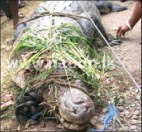
A 15 foot long crocodile, suspected to be a man-eater, was killed on Wednesday, 8 February by villagers in Ragama. The injured crocodile was then taken to the Dehiwala Zoo for treatment, but on arrival was found dead.

The Zoo veterinarian Dr. Jagath Jayasekara confirmed the 900 kilogram marsh crocodile or geta kimbula had a head injury several days old as well as an anchor shaped hook in its body which has severely damaged its respiratory tract and gastro intestinal tract. It had been injured on the head by a sharp object and the wound was 4 inches wide and 2 inches deep and penetrated its skull.
“We were informed of this and prepared for emergency treatment, but the crocodile was already dead before treatment could be given. We discovered this when we opened its mouth,” he said.
“We opened the carcass and found feeding material like cattle hooves, bones, polythene and what we suspect is a human leg and a hand bone. We are yet to receive a confirmation on this,” he said.
According to Jayasekara, it is one of the biggest crocodiles found in recent times in the country and the carcass has been preserved for the zoo museum.

There are two species of crocodiles in Sri Lanka, the mugger or marsh crocodile and the salt water crocodile. While not all crocodiles are ferocious, and some even allow people to bathe or fish in their waters, they are carnivorous and are often perceived as a threat by people living in the vicinity. Crocodiles however are an endangered species and protected under the Fauna and Flora Protection Ordinance. Killing or harming a crocodile is a non-bailable offence and anyone found doing so can be arrested without a warrant.

Nevertheless, according to Jayasekara, it is not the first time that something of this nature has happened. He said  2 months ago, a 10 foot long crocodile was brought in for treatment, but succumbed to injuries before treatment. This crocodile too had been injured badly with a sharp object.
Crocodiles are the top predators in their ecosystem. They feed on fish and prevent larger and invasive species from dominating the eco system. They also feed on weak and sick fish and help keep fish populations and the water clean and uncontaminated. Usually, the presence of crocodiles indicates a clean aquatic environment.

In the past, crocodiles have however been hunted for their hide for the manufacture of handbags, shoes and belts, as well as for crocodile meat. Crocodile meat is dried and sold as medicinal items or even as shark fish. The dried meat allegedly cures asthma. They have also been killed because they are a hinderance to bathing and fishing. Apart from being hunted, crocodiles are  threatened by the destruction or alteration of their natural habitats.


Source:http://www.thesundayleader.lk/2012/02/12/giant-killer-croc-meets-death/

One arrested for selling leopard meat

COLOMBO - A Sri Lankan man was caught red handed by police trying to sell the meat and skin of a leopard, an animal listed in the country’s endangered species list.

After having hunted the animal in the forest reserve adjoining the Adam’s Peak, the man was tring to sell the meat and skin of the animal, said police.
The Bogawanthalawa area, where the Adam’s Peak is located, was declared as a World Heritage Site in 2010. The Sri Lankan leopard is classified as Endangered by International Union for Conservation of Nature.
Police sources confirmed that the full grown leopard was a six-foot long. The offender was selling the meat for less than $ 3 per kilogramme.
news@khaleejtimes.com

Saturday, February 4, 2012

The historic Talangama Wewa is under threat

He sits on a bench pondering over the fate of his beloved Talangama wewa and its environs. The tranquillity and serenity broken only by bird-calls cannot still the turbulence within him today. For, the wewa which helps the 175 farmers of the area to irrigate their land, brings them a bountiful crop of paddy from around 200 acres and calms their frazzled lives by its beauty, is under threat.


This is why 68-year-old E. Percy Perera will fight tooth and nail to protect the wewa in the Madiwela catchment area and its surrounding Wetlands. “This may be the only place in the Western Province where children can actually see an ancient pita vana (for the outflow of excess water) cut through a kalu gala (rock),” he says.

Percy and the other farmers are urging the authorities to raise the level of the spill-basin built in the early 1990s which is diverting water to the Kelani River to stem the flooding of Colombo. The area is not only assailed by this issue – there are also alleged moves by the Sri Lanka Land Reclamation and Development Corporation (SLLRDC) to dig up part of the Wetland and create a man-made lake, bund and all, residents said.

As Percy’s visha vaidya (snake-bite specialist) Seeya K.P.P. Nanayakkara did back in the 1950s, planning the water release to the rice-fields and protecting the ela-wel, Percy has taken upon himself to keep tabs on what is happening at the wewa and guide or fight the authorities whenever the tank or its environs is in jeopardy.

The Talangama wewa originally covering 44 acres is believed to have been built by Parakrama Bahu VI during the Kotte Kingdom. But, smiles Percy taking us down the pathways of history, the tank was not built primarily for irrigation but to bathe the court elephants. The elephants had been taken to a place close to Malabe junction, dubbed athun kedeniya, to be fed and by evening given a dip at the wewa which was the palace thatakaya, before being taken back.


Percy: Fighting tooth and nail to protect his beloved wewa

Gradually, with encroachment the tank had shrunk to 20 acres, says Percy. By 1989-90, when the need arose for more water to be retained in the wewa, the old spill-level was raised by 18”, explains Percy, adding that the tank then reclaimed more than 10 acres of its lost area.

The Colombo Flood Retention Plan to stymie flooding followed, with the SLLRDC putting forward a scheme to construct the spill-basin with a 20” depth. “We feared for the tank,” he eecalls, “for up to then even if there had been a drought for six months, the wewa always had water because it’s fed by ulpath (springs).”

Before the spill-basin was constructed, if there were heavy rains and the tank had excess water, it would spill over the bund and the natural cycle took over with the Wetlands absorbing it. We could also open the pita vana, he says.

But the protests were not heeded and even the plea that instead of a permanent spill-basin, there should be sluice gates which could shut the outflow of water was ignored, laments Percy. “They also cut a canal through high ground in the Amaragoda area,” he says, warning that if there are torrential rains the water will come back along the canal to the lake surrounding Parliament and Parliament would get submerged.


The spill-basin with the water flowing out slowly but surely from the tank has given a raw deal to the farmers. Whereas those days they were able to do both the Yala in April and the Maha in October, if the rains don’t come now no water can be given twice or thrice, grumbles Percy, citing how “kumburu sawuththuvuna” during the Yala of 2011.


The diversion has also caused some parts of the tank to dry up with invasive plant species (such as wel atha) spreading rapidly and the Wetland could very well disappear along with the birds. With the destruction of plants, fewer birds like the kithala (induru kukula) are seen, because they lay their delicate eggs on the nelum-leaf, he says, ecstatic on seeing a flock of seru.


A villager points to the area where the lake is supposed to be dug

Both groups of migrants, which come a-visiting either the north or the south of the country can usually be seen here, says Percy. Backed by the villagers, Percy’s action plan for his heritage is simple:

Raise the spill-basin to store more water in the wewa and if there is excess water after the rains let it flow from the ancient pita vana and through the village like it has done for centuries; clear the invasive plants; prevent land-grabs from the wel-yaya and the wewa reservations; and crackdown on rubbish-dumping and waste-water being channelled into the wewa.

Will Percy succeed in his battle to save the Talangma wewa, its environs (declared a protected area) and the intricate eco-systems while engaging in paddy cultivations like his forefathers did? The answer lies with the bureaucrats. When contacted, an Irrigation Department source said the proposals are being studied.

Walk to create awareness


‘Walk for Wetlands’ from Pelawatte to the Talangama Wetlands next Sunday, February 12, at 9 a.m. will be part of measures to create awareness. Involving the local community including residents, organizations and schools and youth environment groups and environment-conscious organizations, the walk hopes to drive home the message that while enjoying the right to live in a picturesque environment, they also have the responsibility of nurturing and caring for it.

The walk follows an environmental-sociological survey conducted by two past pupils of the Overseas School of Colombo, Olivia Molden (as part of an undergraduate thesis) and Joanne Kotelawala, British Council International Climate Champion and bio-chemistry student.

The main concern highlighted by residents was the increased levels of pollution in the area, while around 50% had indicated that biodiversity loss and filling Wetlands were also recognizable threats. The survey had found that tourism is welcome in the area if it does not clash with the Environmental Protection Zoning.

Who needs a man-made lake?


Confusion and concern surround Kekunugahawatte at Talangama North with residents claiming that some paddy fields and an ela are to be made into a man-made lake while the SLLRDC stressed that only those canals of the existing Averihena wewa would be cleared and dredged.

Whether there is a need to widen the culvert on Amaragoda Road is also being looked into, an SLLRDC spokesperson said. Why should an artificial lake be created, questioned a resident, pointing out that turning marshy habitat into a lake will not necessarily control flooding. It will only increase the water withholding capacity but not the water-absorbing capacity, which is an important factor in flood control. The destruction of the Wetland would be disastrous.

Another SLLRDC spokesperson explained that the Survey Department was demarcating the boundaries as the government was hoping to Gazette the Wetlands to preserve them, while the UDA was drawing up a zoning plan to identify residential and commercial areas. The development work of the Madiwela East canal diversion would only be with regard to the Averihena wewa and other “retention tanks” in the Colombo upper basin.

This area has been declared “environmentally sensitive” by the Central Environmental Authority, the Sunday Times understands, and diverse fauna inhabit the area including many winged beauties
In just one morning, environmentalist Gehan de Silva Wijeyeratne had spotted 70 bird species and according to him, “Talangama is one of the finest urban wildlife sites in the world comparable to the London Wetland Centre which is rated as Europe's top urban wildlife site”.

A large lake would be relatively barren for wildlife compared to the biodiversity-rich natural Wetland which Talangama is at present, he says. It is also home to many mammals including the endemic Purple-faced Leaf Monkey, the Fishing Cat and the endemic Yellow-striped Chevrotain (Mouse-deer), he says in an e-mail, adding that there are also over 30 species of dragonflies.

Source:http://www.sundaytimes.lk/120205/Plus/plus_02.html

Monday, January 23, 2012

Treasury steps in to save jumbo lives

The Treasury has allocated Rs 200 million to the Wildlife Conservation Department to prevent the increasing number of elephant deaths due to train accidents.

The Treasury had released the money on the directives of President Mahinda Rajapaksa.

President Mahinda Rajapaksa had reportedly directed Treasury Secretary P B Jayasundara to lend his fullest co-operation to the project.

The number of elephants killed on account of being hit by trains last year is the highest number recorded so far, according to Wildlife Conservation Department's Elephant Conservation Unit Deputy Director W S K Pathirana.

"Fifteen jumbos, including a number of female elephants and calfs were found dead on rail tracks bordering national parks last year," he said.

"Overgrown shrubbery that have spread up to railway tracks have been the main cause for these accidents," he explained.

"The animals face fatal collisions as they get trapped between the shrubbery and steep embankment on either sides of the track," he explained.

"They go in search of food - leaves, twigs, flowers, grass and water at night. Most elephant-train accidents take place during late hours between 6 pm to 5 am," he added.

He said the Wildlife Department has commenced clearing the railway tracks in Kanthale where elephant deaths are frequent.

The department has started the activity with Sri Lanka Railways.

A 10-mile stretch of track is to be cleared to provide safe passage for the elephant under the project, he said.

Meanwhile, elephant conservators thanked the President stating that this is the first time that any government has allocated so much funds to resolve the human-elephant conflict.

Steps will be taken under the project to fill more stones between the sleepers of the tracks to prevent the elephants from getting stuck between them, they said.

Elephant Conservation Deputy Director Pathirana said they had discussions with Transport Minister Kumar Welgama about using 'night vision' cameras to monitor the movements of elephant herds as the trains wend their way through accident prone areas of the forest.

Minister Welgama has agreed to install infra-red night vision to facilitate the process of monitoring elephant movement at night as a pilot project, he said.

Source:http://www.dailynews.lk/2012/01/24/news18.asp