Saturday, July 23, 2011

Near extinct fish faces death by dynamite

Dynamited to death in the Mahaweli Ganga at Waratenna, Getambe, has been the fate of an ‘endangered’ endemic freshwater fish which has not been sighted for at least five years and was believed to be extinct in Sri Lanka.
While for three weeks blasts have been rocking the peaceful environs of Waratenna close to the Seemamalakaya on the Peradeniya-Katugastota Road, the sudden activity in connection with the groundwork for a mini-hydro power project has left the gadeya or Green Labeo (Labeo fisheri) dead, the Sunday Times learns.
The belief was that the gadeya was extinct worldwide, says researcher Pradeep Samarawickrama, explaining that about four months ago it was re-discovered by him at Waratenna. Earlier this fish was found in the Mahaweli system, at Polgolla and near Victoria, but with the construction of the dams under the accelerated Mahaweli Scheme, their habitats were submerged and changed.
The Waratenna area in which the fish was found. Pix by Pradeep Samarawickrama
Then it was assumed that the fish may be extinct but with Mr. Samarawickrama picking up the dead and decomposed fish it now indicates that the gadeya had made the Waratenna area its home.
“These sites should be preserved,” he stressed, without indiscriminate dynamiting of the rocks embedded in the riverbed.
Another serious concern that this researcher raised was the impact of such blasting in an area which is heavily landslide-prone, with the government on one hand requesting people to be cautious.
Adding his voice to the concerns expressed by Mr. Samarawickrama including the need to preserve the ‘last habitats’ of this nearly-extinct fish, environmental lawyer Jagath Gunawardena quoting Section 27 of the Fisheries and Aquatic Resources Act said that any act or negligence that causes the death of any fish by the use of explosives is an offence.
He questioned the integrity and inaction of the Mahaweli Authority, which being the project-approving body, has the responsibility of monitoring the implementation of the project that it had approved in the first instance.
Referring to the gadeya, Mr. Gunawardena said it was earlier found in areas such as Lewella, Tennekumbura and the lower regions of the Hulu Ganga but in the early 1980s it was predicted that 75% of the known habitats of this fish would go under water due to the construction of the Victoria reservoir.
“But now we realize the gadeya has been able to re-establish itself upstream,” he said.
He lamented that due to short-sighted policies, these areas too would be destroyed. “L. fisheri has been assessed as ‘endangered’ due to its restricted range (extent of occurrence less than 5,000 km2), continuing decline in habitat quality and the fact that the species is considered to be found in less than five locations,” according to the 2011 Global Red List of the International Union for Conservation of Nature (IUCN).
This species is found only in the mid to upper reaches of the Mahaweli Ganga basin, it states, explaining that L. fisheri may already be extinct, as a result of habitat loss following the Mahaweli Ganga development project.
Referring to habitat and ecology, the Red List states: “L fisheri is a benthopelagic species that only inhabits deep, fast-flowing sections of the river. It has not been recorded from unshaded, silty or turbid waters. It moves fast through the water, staying close to the bottom.”
It was way back in 1980 that Ranil Senanayake predicted that the Polgolla and Victoria projects of the Mahaweli Scheme would destroy the gadeya’s habitat while in 1990, Dr. Eric Wikramanayake said that this fish may already be extinct.
Bigger than originally believed
It was believed to grow only to 30 cm. but researcher Pradeep Samarawickrama has found a gadeya which is nearly twice that size, close to 60 cm. in length.
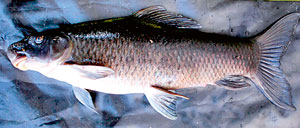
Sadly the fish is dead, due to companies which think only of short term gain and government authorities which do not do their jobs, said a conservationist while many others joined their voices to his, in pointing an accusing finger at the Mahaweli Authority for not acting quickly, even now, to stop the destruction of the gadeyas’ habitat and re-evaluate the project.
Earlier, the known maximum length of this fish as reported by Dr. Paul Deraniyagala in his ‘Vertebrates of Ceylon’ Volume I published in the 1950s; the ‘Freshwater Fishes of Sri Lanka’ published by Rohan Pethiyagoda in 1991; and all other references was 30 cm.
However, a dead fish picked up by Mr. Samarawickrama is nearly twice that length.
Blasting going on despite warning
The company involved in the project has been warned to halt the blasting with immediate effect, said Mahaweli Authority Director-General D.M.C. Dissanayake who has sent a three-member inquiry team to the spot.
I am waiting the report, he said. However, the Sunday Times learns from residents in the area that work has not been halted and the blasting was going on even yesterday, with the whine of backhoes dumping the blasted rock onto one side continuing throughout the day, aggravating the already disturbed habitat.
Meanwhile, Central Environmental Authority Chairman Charitha Herath said that the CEA has not given its concurrence for the latest work at that spot.
The CEA has asked all stakeholders including the company involved to come for an urgent meeting on Tuesday, he said, detailing the background to the Sunday Times.
In 2007, a proposal was put forward to set up a mini-hydro power plant there and environmental approval sought. The Mahaweli Authority as the project-approving agency set the terms of reference for an environmental impact assessment (EIA). The EIA was reviewed by the Mahaweli Authority and the CEA asked for concurrence and as there were no public comments it was given, says Mr. Herath.
The concurrence was for a three-year period from February 2007 to February 2010, during which time they were supposed to build the plant. However, the project was not started and the approval expired on February 2010. Recently, CEA concurrence was requested once again, but we have not given it. That’s why we called a meeting on July 26 to discuss it. However, we have received complaints that the project has been started.
Environmental lawyer Jagath Gunawardena, however, cites Section 24 B of the National Environment Act, according to which the CEA can issue a directive ordering the suspension of all activities of a project that is implemented without its permission. If this directive is not heeded the CEA can go to the Magistrate’s Court and get it implemented as a court order, he adds.

Source:http://www.sundaytimes.lk/110724/News/nws_69.html

Friday, July 22, 2011

Leave the animals their territory

The recent fatal leopard attack on a pilgrim of the annual Pada Yatra, raises questions about the ‘goings on’ inside the Yala National Park.
Kumudini Hettiarachchi reports
The anguished shriek of "Appah" rent the early morning stillness, sending the bleary-eyed Pada Yatra devotees running to the bank of the Menik Ganga in the Yala National Park.
It was dawn on Sunday, July 10, and the scene that met the devotees who rushed to the scrub jungle on the river-bank sent chilling fear up their spine. Right before their eyes, a leopard with its jaws clamped over the bloodied neck of 31-year-old Krishnapulle Chandrakumari was dragging her into the jungle. It was only a frenzy of shouting that made the leopard ease its vice-like grip, the Sunday Times understands, but even while they were carrying her to the place where they had laid down their weary heads the previous night on the dried up riverbed the predator had been slinking about in the vicinity, growling in anger, having to be warded off with firebrands.

On the move: Pada Yatra pilgrims (file pic)
Chandrakumari, a mother of a six-month-old baby and six-year-old boy, was dead. A Samurdhi Officer from Thirukkovil in the east, she had joined the Pada Yatra with a heavy heart - to fulfil a vow taken on her husband's behalf. For, he was paralysed below the waist after being involved in an accident.
She and the members of the 'nade' had come the previous night (July 9) to the Menik Ganga, lit a fire, had a scrap dinner and slept on the sandy river-bed. The Menik Ganga has dried up and there is only a sliver of a stream flowing sadly.
In the early morn having boilt and eaten a meagre meal of bada iringu, Chandrakumari had gone about 25 metres from the river-bed to the river bank on the side of Block 1 for her morning ablutions when she met with an agonizing death far away from home, many sources said, quoting witnesses. Behind this unfortunate leopard attack lies a horde of issues, stressed conservationists, howling in protest at the "goings on" inside the Yala National Park.
Reconstructing the tragic scene in detail, Sajeewa Chamikara of the Nature Forum underlines the fact that the attack took place about 500 metres from Negeniyangastota, one of four camping sites allowed by the Department of Wildlife Conservation (DWC) in Block 1. There seems to be a connection with the campsite as there are serious concerns that a particular group that camps here, enticing foreigners and their big bucks with assurances of "sure sightings of leopards" lure the big cats here by feeding them beef regularly, said Mr. Sajeewa (See box).
Previous attacks by leopards and other animals
  • 2006 - A Pada Yatra devotee had been mauled and killed by a bear in Block 2 while a woman had been killed by a tusker at Katagamuwa in Block 1
  • 2005 - Another woman on the Pada Yatra had been killed once again at Katagamuwa by a tusker.
  • About 25 years ago a leopard had attacked and injured a tracker at the Heenwewa bungalow staff quarters. The same leopard had attacked about three others, but no one was killed.
  • 1924 - The man-eater of Punani killed many people.
  • 1910 - A Pada Yatra devotee had been killed close to the Poththana wells and the same leopard is believed to have killed around six more people.
What can you expect of leopards when humans dangle beef before them as bait, he asked, critical of those who would do anything for money, not caring a tuppence for the consequences. Poor Chandrakumari may have paid with her life because of the greed of others, he said, a view echoed by many conservationists.
Check out their Facebook promotions, Mr. Sanjeewa said, adding that it shows clearly a photograph of a leopard near the campsite, with a large bonfire burning merrily. Usually leopards would move away from such areas, but what is the attraction, he argued, answering, isn't it obvious it is food.
Feeding of wild animals to get them for viewing at close quarters was one of the dangers that conservationists pointed out when expressing grave concern over proposed moves to build hotels in the buffer zones of Protected Areas as reported in the Sunday Times of July 3.
However, a spokesman for the campsite operator vehemently denied the allegations which he claimed were baseless and asked whether anyone had seen them feeding the leopards. He pointed out that DWC officials were with them and would prohibit them from such actions.
This is not the only allegation against this particular campsite operator, according to Mr. Sajeewa. When the waters of the Menik Ganga inundate the campsite during the rainy season, the operator allegedly clears the forest and moves the site further inland, he said, pointing out that this was against all the laws governing the Yala National Park which is a Protected Area.
After Sunday's attack, there had also been alleged military comments that the leopard will be shot, said Mr. Sajeewa, questioning how anyone could shoot any animal in a National Park let alone one of a handful of the top predators, a leopard. The National Park is the designated home of these animals and how can humans who intrude on their territory come up with such threats which are a clear breach of the law. The other question is: How will anyone distinguish the problem leopard from the others, or will they take the liberty of killing all leopards on sight.
Another conservationist pointed out that though the Pada Yatra has traditionally gone through the Yala National Park, in the last two years the number of devotees has swelled. This year, a crowd of about 28,000 has passed through while last year it was close to 26,000. Some of these groups don't behave like devotees, they sing, they make a huge noise, they set up wadi all along the river and they litter the park with polythene and the remnants of ganja, turning the National Park into one big camping ground.
This affects the life of the animals, he said, especially their home range, corridors and access to water. This is the dry season and when humans are roaming along the river, they cannot get to water.
ouldn't aggression come about naturally?
The other major concern was expressed with regard to the army putting up four boutiques along the Pada Yatra route - Warahana, Kosgasmankada, Katupila- ara and Pallepoththana -- within the Yala National Park in clear violation of the Fauna and Flora Protection Ordinance. A conservationist pointed out that not only were they supplying kadala along the route but they were also selling fizzy drinks, packets of biscuits and water bottles. Not just a few hundred but thousands of bottles, he alleged, asking where these devotees dumped used bottles and polythene packets, except in the park itself.
The tragic attack on Chandra-kumari should be a forewarning. Limit Pada Yatra crowds through the National Park, with DWC officials around them to advise and provide guidance, according to conservationists.
Or why not have the Pada Yatra re-routed along existing roads around the Park, asked another.
The warning is timely. Leave the animals their territory, for each and every one of these animals, from the smallest worm to the largest elephant, is needed in the eco-system, for the very survival of humans.
Many attempts to contact the Director General of the DWC failed as he was said to be abroad.
Attack an anomaly: Leopard Researcher
Last Sunday's attack at Yala is "very strange" for Sri Lankan leopards, points out conservationist and leopard researcher Rukshan Jayewardene. "It is an anomaly."
Explaining the "normal behaviour" of Sri Lankan leopards, he says whenever human beings move in and out of forests for various reasons such as collecting firewood they never get menaced or attacked by these big cats. Leopards will cautiously and warily watch from a distance or evade and slink into deeper forest.
This is because the leopards have plentiful prey, "their kind of food", such as deer, buffalo and wild boar and they don't see humans as what they eat naturally, he stresses. In the case of cubs who have seen humans from the time they were born, even when they grow up they would ignore humans. That's how you have "close encounters" with them at Yala and see them crossing between vehicles.
Humans are not the food of Sri Lankan leopards, he explains, adding that in India, leopard behaviour is different because their usual food sources are not abundant. Sometimes in marginal areas in Sri Lanka, if their food sources are scarce they would attack dogs and goats and in the process get snared, poisoned or shot.
Delving into the leopards' psyche why they keep a good distance from humans, Mr. Jayewardene says their perception is that we are bigger than what we really are because they are not at our eye level. If they can look into our eyes, they feel we are a smaller animal that they can attack and subdue. That's why most leopard attacks are on people squatting or kneeling, which gives the creature the impression that we are like a medium-sized animal. They make a correct assessment of our size only when they see us at that level, otherwise their perception of us is that we are larger and heavier creatures than what we actually are. So they leave us alone.
Of course, according to Mr. Jayewardene, the exception to the rule of the natural inhibition leopards have against attacking humans is the seasoned man-eater. Something has happened to make the man-eater cross that inhibitive barrier between animal and human. It could be that it accidentally attacked a human and at th same time being hungry got the taste of flesh and blood, tempting it to turn to this easy food source. With such a first attack the leopard also realizes that humans are easy to kill and not very heavy to drag.
Taking the attack on Chandrakumari, he says, "it's ominous", with the danger of the same leopard attacking again. There are all indications that it was not an accidental attack, on being suddenly surprised in the undergrowth, because then it would have pounced, killed and left her. The aggression, focused attention and predation factor, as opposed to an accidental killing, could be established by reports that it attempted to drag her into the jungle and even when thwarted and her body was carried to the river-bed with lots of people moving around, it lingered menacingly. The question which arises is whether he has preyed on humans before, maybe a poacher or gem miner, the killing of which would have gone unreported because they would have been in the National Park illegally.
When asked about reports that a leopard had been seen close to an army-run shop at Yala, he warns that the danger seems imminent and the DWC needs to shut down the campsites in the vicinity of the attack temporarily to avoid another attack and take urgent action to check out the cause.
"One quick way to make a harmless leopard or any wild animal a problem is to make it associate humans with food," warns Mr. Jayewardene categorically, when the Sunday Times queried about the allegations made that one particular group running a campsite at Yala (incidentally close to where Sunday's attack took place) was feeding leopards with beef to get them to be around the area, so that they could boast of "assured sightings" to foreigners and make a quick buck, without thinking of the consequences.
When the leopards are denied such throw-downs of food, they may very well resort to aggression, he said.

Source:Sundaytimes

Speeding vehicles on roads driving wildlife to their early graves

By Malaka Rodrigo
A fully grown sloth bear was killed by a speeding vehicle near the 11th kilometre post on the Panama-Pottuvil road late last month raising concerns over the prudence of having public roads across biodiversity rich National Parks, while vehicles speeding along roads in rural areas also drive wildlife to their graves before their time.
The ill-fated bear was found lying on the side of the road with apparent head injuries. The Ampara office of the Wildlife Department had been promptly alerted, but the animal was already dead due to injuries it suffered. The wildlife veterinary surgeon Dr. Pramuditha Devasurendra who had conducted the post-mortem confirmed the animal died due to damage to its skull. There were signs of profound bleeding from its mouth. The bear's fur coat also had mud stains indicating it could have been hit by a heavy vehicle with large tyres.
Dr. Devasurendra also said there were signs that the vehicle has gone over one of the animal's legs. The bear was a well grown male around eight to nine years old. The body of the bear was sent to the Giritale wildlife facility to be stuffed.
Samitha Harichandra, the managing trustee of the Wildlife Research and Conservation Trust of Sri Lanka who visited the accident site soon after he was alerted, recalled spotting a bear on the same stretch of road recently while he was driving at night. He said he had seen the bear on two occasions and the ambulance driver of the area hospital too has confirmed sighting this bear indicating the animal must be roaming around the area (a territorial bear) near the 11th kilometre post.


The sloth bear killed on the Panama-Pottuvil road
This is the season when the palu and weera berry ripens attracting usually secretive sloth bears out of their hideouts in search of the berries. Mr. Harichandra recalls that there are many weera and palu trees in the scrub jungle on this stretch of the Pottuvil road, luring the secretive bear into the open, making it an unfortunate road victim.
The sloth bear in Sri Lanka is a separate subspecies scientifically categorized as Melursus ursinus inornatus. Their numbers are declining, with them being already categorized as vulnerable to extinction in the IUCN Redlist scale.
Mr. Harichandra says the annual Okanda pilgrim season increases vehicular traffic along this road which becomes a death trap to wild animals of the area. The presence of such a rare animal like the sloth bear is an indication of the quality of the scrub jungle which must be home to many animals.
Harichandra complained that drivers should be more vigilant when speeding on rural roads to avoid killing animals.
He said that as the road network gets better in these areas, drivers tend to speed on long stretches of roads that do not have much traffic. But animals need to move around their natural habitats and require to cross these roads. They virtually have no time to escape from a speeding vehicle, he said.
Slow moving small creatures like tortoises, snakes, and porcupines face the greatest risk when crossing the roads. But even fast movers like civets can fall easy prey at night when they freeze in the middle of the road blinded by the glare of headlights. Some animals like the porcupine have the habit of staying motionless when they feel a threat, making them sitting ducks. Even birds and monkeys can't escape at times from speeding vehicles.
But it is not only the smaller animals that are being hit by careless drivers. On many occasions elephants have also been hit on public roads. In one such incident at Galgamuwa/Ambanpola, a sleepy bus driver hit an elephant at night on the road near the Thekkakele forest. The front of the bus was badly damaged and the conductor was killed in the accident. A few months later, another elephant was hit by a van and the enraged elephant turned on the humans killing a passenger in the van.
Though these elephants recovered with injuries, there were incidents where jumbos get killed in road accidents. At Medawachchiya, a baby elephant of about four months had been killed instantly when it was hit by a tipper. The accident occurred around 1 a.m. and the body of the calf was badly smashed, indicating the vehicle was traveling at speed. Another calf was the victim of a roadside accident at Habarana last year.
It is however hard to provide a solution to such unfortunate accidents as drivers tend to speed in their vehicles on open stretches.
One way to minimize such accidents is by setting up speed limits and placing warning boards in areas where wildlife is abundant. But while wildlife conscious drivers will take note, it is a question whether reckless drivers will abide by the rules.
At present most of the drivers even do not honour the speed limits set up in populated areas which are also frequently monitored by the Traffic Police. It is virtually impossible to set up traffic checkpoints at night so there is little hope that rules would be observed on remote road stretches. Wildlife lovers call all drivers to be vigilant when driving through remote roads.

Roads across National Parks
With animals being killed by speeding vehicles, wildlife activists question the prudence of opening up of new public roads across Protected Areas. A road across the Wilpattu Sanctuary has been opened last year amidst the objections of the wildlife community and there seems to be attempts to open up other roads. Though speed limits are set and traffic allowed during the daytime in wildlife rich habitats, such roads will still be death traps.
There are other dangers for wildlife as a road will increase human presence which will also increase illegal activities. Poachers will get a ready-made market to sell bush meat. More importantly, a public road will also cause a genetic isolation of animal groups between two sides by restricting animal movements. In a free environment, wild animals would mix with each other but a road will halve their movements isolating them genetically or depriving them of their traditional feeding grounds. This will also degrade the quality of their gene pool.

A tortoise run over by a speeding vehicle
The danger of public roads across national parks was in the international spotlight last month as an attempt to construct a commercial road across some parts of Serengeti National Park in Tanzania has been abandoned.
Each year about two million herbivores including wildebeests and zebras make their way from the Serengeti National Park to the Maasai Mara reserve in Kenya.
Environmental activists raised concerns that the new road will restrict the animals' movements and halve the animals in the park. Tagged as one of the planet's greatest natural spectacles attracting thousands of major tourists, the road could have also affected the local economy, in which tourism plays a major role.
The Tanzanian government consequently abandoned the idea of constructing a stretch of 53 kilometres of road to avoid areas of high conservation value.
Likewise, Sri Lankan conservationists also raise the question whether we still need to have roads to make for quicker traveling. If quicker traveling is the need, speed limits cannot be set, ultimately resulting in many road accidents.
Speeding in wildlife parks
Yala National Park has already been infested by the over-visitation bug where around 200 vehicles go in on busy days. The visitors' prime aim is to have a glimpse of Yala's star attractions - leopard, bear or elephant. On receiving a message of a sighting, the vehicles rush to the spot to get a better view.
The safari jeep drivers' often forget they are in a wildlife national park. There is every chance these speeding vehicles too can hit an animal. So if you happen to be in a safari jeep, never allow it to be driven at an uncontrollable speed even though it might cost you a better sighting of a wild animal.

Source:Sundaytimes

Steady increase of elephant deaths due to ‘hakka pattas’


The use of hakka pattas, (a homemade explosive device concealed in fruits etc.), has led to a steady increase in elephant deaths, says Elephant expert Jayantha Jayawardene.

He told The Island yesterday that the situation was going from bad to worse.

Meanwhile, Hambantota District Secretary R. M. W. B. Meegasmulla said that crackers used to scare elephants should only be distributed among those communities highly vulnerable to elephant attacks.

Experts have pointed out that many elephants, especially in Hambantota, suffer from disabilities due to the use of crackers.

Source:Island

Sri Lanka, a wildlife 'Hot Spot' - The West Australian

Sri Lanka is a wildlife Hot Spot, boasting more than 400 species of birds and large game such as buffalo, crocodile and elephant, while also reputedly being the best place in the world to spot leopards, The West Australian said. Writer Liam Creedon states after throwing off the shackles of a war, Sri Lanka has woken up to its vast tourist potential.
As a result, Sri Lanka is fast becoming a top wildlife destination and a six-day tour promised to provide a glimpse of the island's impressive diversity, he said.
Sinharaja rain forest reserve is an amphibian hotspot, with new specimens still being discovered, The West Australian added. "Our next destination was the Yala national park the island - the home of Sri Lanka's other great feline icon - the leopard," the writer said.

Courtesy www.priu.gov.lk

Saturday, April 30, 2011

Kilinochchi leopard caught in snare rescued by wildlife officers

Snares are the worst death traps for Sri Lankan leopards and their latest would-have-been victim is from Kilinochchi. This leopard was lucky to survive due to the timely and brave action by the wildlife officers of Vavuniya. As soon they received the message, the officers had rushed to the site in Kilinochchi.
They found the leopard in an exhausted state after trying to free itself from the snare. Usually when a leopard gets caught in a snare, the wire tightens around its crotch area damaging the vital internal organs such as the kidneys.
A leopard has to be usually sedated before anyone can get close to it, however, the wildlife veterinarian of the region was engaged in another duty, so there was nobody to tranquilize this trapped leopard.
However the officials realizing that there was no time to be wasted and since the animal appeared to be exhausted they thought of a new tactic to get close enough to it to cut the wire of the snare.
They secured themselves inside a steel cage and got close to the leopard. Holding the exhausted leopard to the ground by using a few sticks, they succeeded in cutting the wire by using a long handled tool. The leopard slowly made its way back to the jungle and although it was exhausted, the officers believed it would survive.
It is believed that a local cattle breeder has setup the snare to trap a leopard which had killed several of his cattle.
Source:http://www.sundaytimes.lk/110501/News/nws_01103.html

Leopard succumbs to gunshot wound

Another full-grown young leopard, about 7 feet from head to tail, died an agonizing death in Balangoda last week. Estate workers of Dethangolla off Balangoda saw the wounded leopard lying near a small stream.
The leopard was alive but could not move because its paralyzed hind legs were stuck under a fallen tree. The Department of Wildlife Conservation (DWC) was alerted, while estate workers stood watch over the exhausted leopard. The Elephant Transit Home (ETH) of Udawalawe was the closest medical facility belonging to DWC, and a team was immediately dispatched from the home in a bid to save the animal.
Helper holds in palm of his hand the bullet that had penetrated the leopard’s spine.
The leopard had six gunshot wounds, and one bullet had penetrated its spinal cord, paralysing the hind limbs, according to the ETH veterinary surgeon. As there were no signs of a struggle in the vicinity of the dead animal, it is believed that the leopard might have been shot at a distance, and that the animal had dragged itself a long way. The leopard’s underside showed signs of bruises and scratches.
Dr. W. D. L. Udaya Kumara, who oversaw the initial treatment after sedating the animal, said there were maggots in the wound, indicating that the animal might have been shot two or three days earlier.
The leopard was lying in a forested area and taking a vehicle to the spot was a problem. The team had to carry the animal 500 metres along a hill path. The heavy animal was carried to the vehicle with its legs tied to a pole. Although it was late evening, a large crowd had gathered around the DWC vehicle to get a glimpse of the big cat. Dr. Kumara heard from estate workers that the leopard had not been seen in the area before.
On arrival at the Elephant Transit Home, in Udawalawe, medical staff immediately set to attending to the leopard. The hind legs were completely paralyzed. It was found that the leopard had bitten its own legs and tail. The leopard’s condition deteriorated, despite the wildlife officers’ efforts, and the animal died the following day.
The carcass was sent to the Girithale wildlife facility, where Southern Region veterinary surgeon Dr. Vijitha Perera performed a post-mortem. Lead shots removed from the wounds suggested that they had come from a muzzle-loading gun. The vets believed the leopard had been shot sevral times at close range.
Reasons for the shooting remain a mystery. Leopards that live close to human habitats are careful to conceal themselves from humans. They usually do not attack humans and stealthily move away when they sense an encounter.
However villagers aware of the presence of a big cat may panic, fearing the animal might prey on domesticated dogs and cattle. The leopards are therefore hunted to protect livestock or pet animals. Leopards are also vulnerable to poachers who hunt the animals for their skins.
But if this leopard was targeted for its skin, the poacher or poachers would have had time to skin the crippled animal. It is also a known fact that some estate owners like to hunt leopards for the thrill of it, and use hunting dogs for the purpose.

Source:http://www.sundaytimes.lk/110501/News/nws_22.html